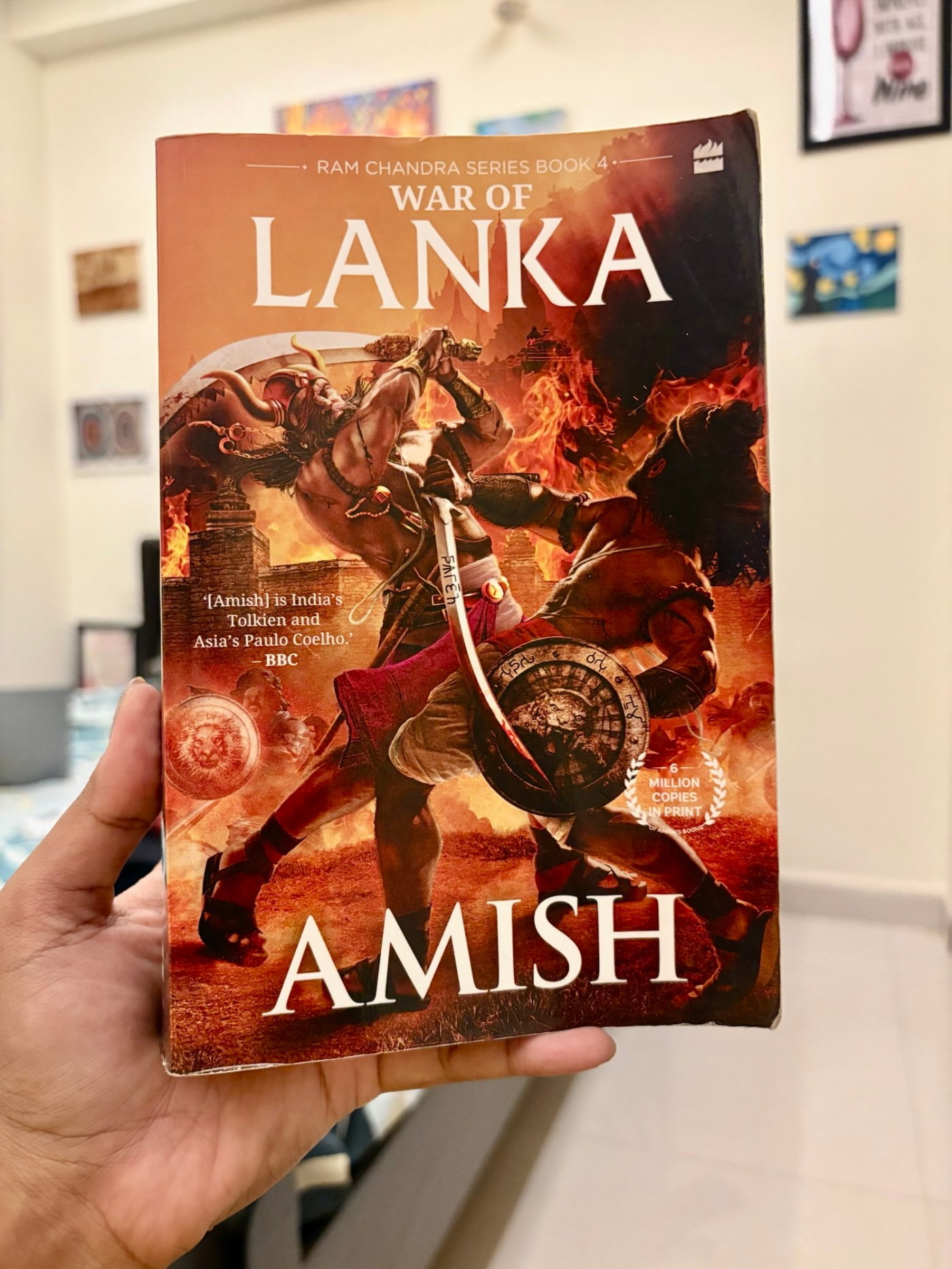
Have you ever loved a book series so much that, when you reached the last book, you deliberately didn’t finish it?
Not because you didn’t want to know how it ended. But because you loved the author, the characters, and the world so much that you didn’t want the story to end.
That was me with the War of Lanka.
My journey with Amish Tripathi’s books began back in college. Until then, reading had slowly disappeared from my life. Preparing for IIT meant years of Math, Physics, and Chemistry. Even after joining IIT Madras, I didn’t really return to books. I was visiting an old friend when I spotted The Immortals of Meluha on her bookshelf. The cover of the book captivated me. My friend loved the book, so I thought, Okay let me give it a shot.
I had no idea what I was getting into.
The Immortals of Meluha was the story of Shiva, but not the Shiva I had grown up hearing about. Amish took characters we knew as gods and retold their stories through a human lens. They had emotions, doubts, flaws, choices, consequences. Instead of simply accepting them as divine figures, you began to wonder: What made these people become the characters we remember centuries later? Why were they loved? Why were they hated? What choices shaped their legacy?
I couldn’t put the book down, finished it in days. I immediately picked up the next book The Secret of the Nagas. And then came The Oath of the Vayuputras. I still remember walking into Crossword, buying it, finding a place to sit, and finishing it in a day!
The Shiva Trilogy became much more than a series for me. I often credit Amish for bringing me back to books. But more importantly, those books helped me reconnect with my own Indian roots. We grew up surrounded by mythology, history, traditions and stories. Yet sometimes, because something has been passed down for generations, we stop questioning it. We stop distinguishing between what is valuable and what is merely tradition. Between a good custom and a harmful one. Between values that ground us and superstitions that limit us.
What followed in my life is a series of books in similar genre by authors like Anand Neelakantan, Ashwin Sanghi, Chitra Banerjee Divakaruni. These books made me look at our Indian stories differently. They made me think about values, about character, about what makes a person who they are. And over time, I realised that our values, and the red lines we draw for ourselves are what ultimately shape our character. Those red lines are deeply personal. What matters is understanding them consciously rather than simply inheriting them.
A lot of my own personal growth, I realise now, has come through books. After the Shiva Trilogy came the Ram Chandra Series. I was especially excited about this one because I knew the Ramayana in and out, thanks to my grandfather who recited poems and told us stories everytime we visited. But my understanding was primarily through the lens of mythology. What would happen if these familiar characters were explored as human beings, with emotions, motivations, and dilemmas?
Ram retold the story through that lens, giving human emotions to these individuals, exploring why they made the choices they did, what makes Ram ‘Ram’, or what makes these characters stay alive in our collective memory centuries later, travelling across generations, across India and beyond, becoming intertwined with different cultures along the way.
Then came Sita, the Warrior of Mithila. Fierce yet serene. Strong yet deeply grounded. Captivating, but with a calming presence. Invoking profound respect. Seeing the story through her perspective added a new lens to the character I thought I already knew. Amish’s Sita became my Sita.
Then came Raavan. The backstory. The layers. The contradictions. A character who is so often reduced to a single word ‘Villian’ suddenly became far more complicated and human.
And then the War of Lanka. The final book. Which is exactly why I didn’t want to finish it. I started reading it and then stopped. I kept telling myself, If I finish this, I’ll miss it. So I put it back on the bookshelf, neatly in its place, waiting for the right time.
That time came recently. Life has been going through some difficult moments, and I found myself reaching for this book again. Perhaps I was looking for a little light. And I found it. I finished the War of Lanka today. There is a peculiar joy in completing something you have been carrying with you for years. A joy that can overshadow the gloom around you, even for a little while. That is what this book left me with. A smile. A thought. And several conversations with myself.
I won’t give away a single spoiler. I genuinely believe that reading these books is an experience one should have for themselves. What Amish does, at least for me, is not simply a retelling of mythology or propaganda. He makes you look at familiar stories through a different lens. You may know the ending. You may know the characters. You may know the history. And yet, somehow, you find yourself asking different questions.
Why did they make that choice?
What made them who they became?
What would I have done?
And perhaps most importantly:
What do I believe?
That is the beauty of these books for me. They don’t just tell you someone’s story. They leave you thinking about your own. The stories we think we know are worth reading again because perhaps we are no longer the same person who heard them the first time.
And thankfully, I have one more Amish book waiting for me, The Chola Tigers, so I have another journey to look forward to.
If you haven’t read Amish yet, pick up one of his books. You might just look at history, mythology, and perhaps even yourself, a little differently.


Leave a comment