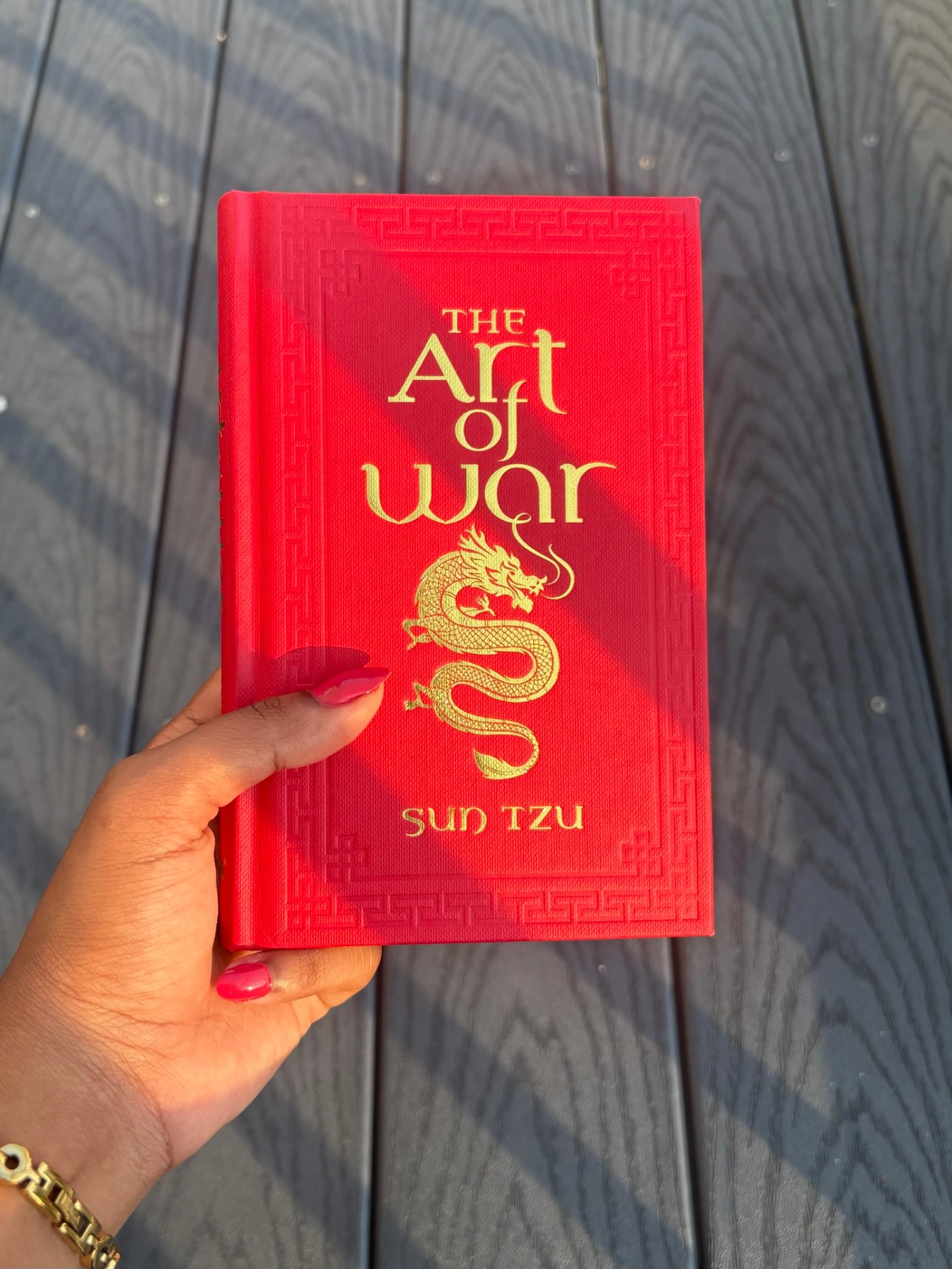
I think everyone should have a copy of The Art of War.
It doesn’t really matter who you are or what you do. If you’re in leadership, decision-making, diplomacy, bureaucracy, military strategy or honestly, just navigating situations where people, power, and choices collide, there is something in this book for you.
What I found fascinating is how Sun Tzu keeps making you think you’ve understood where he is going, only to completely shift your perspective in the very next line. You read something and think, “So this is how I would handle it.” And then the next thought makes you stop and go, “Oh. I could have handled it this way instead.”
And perhaps that is the real lesson of the book: strategy isn’t about knowing one right answer. It is about understanding people, circumstances, timing and consequences well enough to know which answer works now.
Because when you think about it, war is an art.
So is peace.
And perhaps you cannot truly understand the art of peace without first understanding the art of war.
Sharing a few of my favorite lines from the book here:
“All warfare is based on deception.”
“The art of war teaches us to rely not on the likelihood of the enemy’s not coming, but on our own readiness to receive him.”
“Pretend to be weak, so that your opponent may grow arrogant.”
“Many calculations lead to victory and few calculations to defeat.”
“Opportunity of defeating the enemy is provided by the enemy himself.”
“Energy may be likened to the bending of a crossbow, decision to the releasing of a trigger.”
“Simulated disorder postulates perfect discipline, simulated fear postulates courage, simulated weakness postulates strength.”
“If he sends reinforcements everywhere, he will be weak everywhere.”
“Let your rapidity be that of the wind, your compactness be that of forest. In raiding and plundering be like fire; in immovability like a mountain. Let your plans be dark and impenetrable as night, and when you move, fall like a thunderbolt.”
“A clever general avoids an army when its spirit is keen, but attacks it when it is sluggish and inclined to return. This is the art of studying moods.”
“When you surround an army, leave an outlet free. Do not press a desperate foe too hard.”
“There are roads which must not be followed, armies which must not be attacked, towns which must not be besieged, positions which must not be contested, commands of the sovereign which must not be obeyed.”
“Five dangerous faults which may affect a general: recklessness, which leads to destruction; cowardice, which leads to capture; a hasty temper, which can be provoked by insults; a delicacy of honor, which is sensitive to shame; over-solicitude for his men, which exposes him to worry and trouble.”
“Soldiers must be treated in the first instance with humanity, but kept under control by means of iron discipline.”
“The general who advances without coveting fame and retreats without fearing disgrace… is the jewel of the kingdom.”
“Those who were called skillful leaders of old knew how to drive a wedge between the enemy’s front and rear, to prevent cooperation between his large and small divisions, to hinder the good troops from rescuing the bad, the officers from rallying their men.”
“The skillful tactician may be likened to that of Shui Jan. Shui Jan is a snake that is found in the Chang mountains. Strike at its head, you will be attacked by its tail. Strike at its tail, you will be attacked by its head. Strike at its middle, and you will be attacked by both head and tail.”
“The skillful general conducts his army just as though he were leading a single man, willy-nilly by the hand.”
“Be subtle; use your spies for every kind of business.”
“Supreme excellence consists in breaking the enemy’s resistance without fighting.”
“It is only one thoroughly acquainted with the evils of war who can thoroughly understand the profitable way of carrying it on.”
“It is ironic that Sun Tzu, perhaps the greatest writer on war, was alive and at work at the same time as China’s most illustrious man of peace, the great sage Confucius.”


Leave a comment