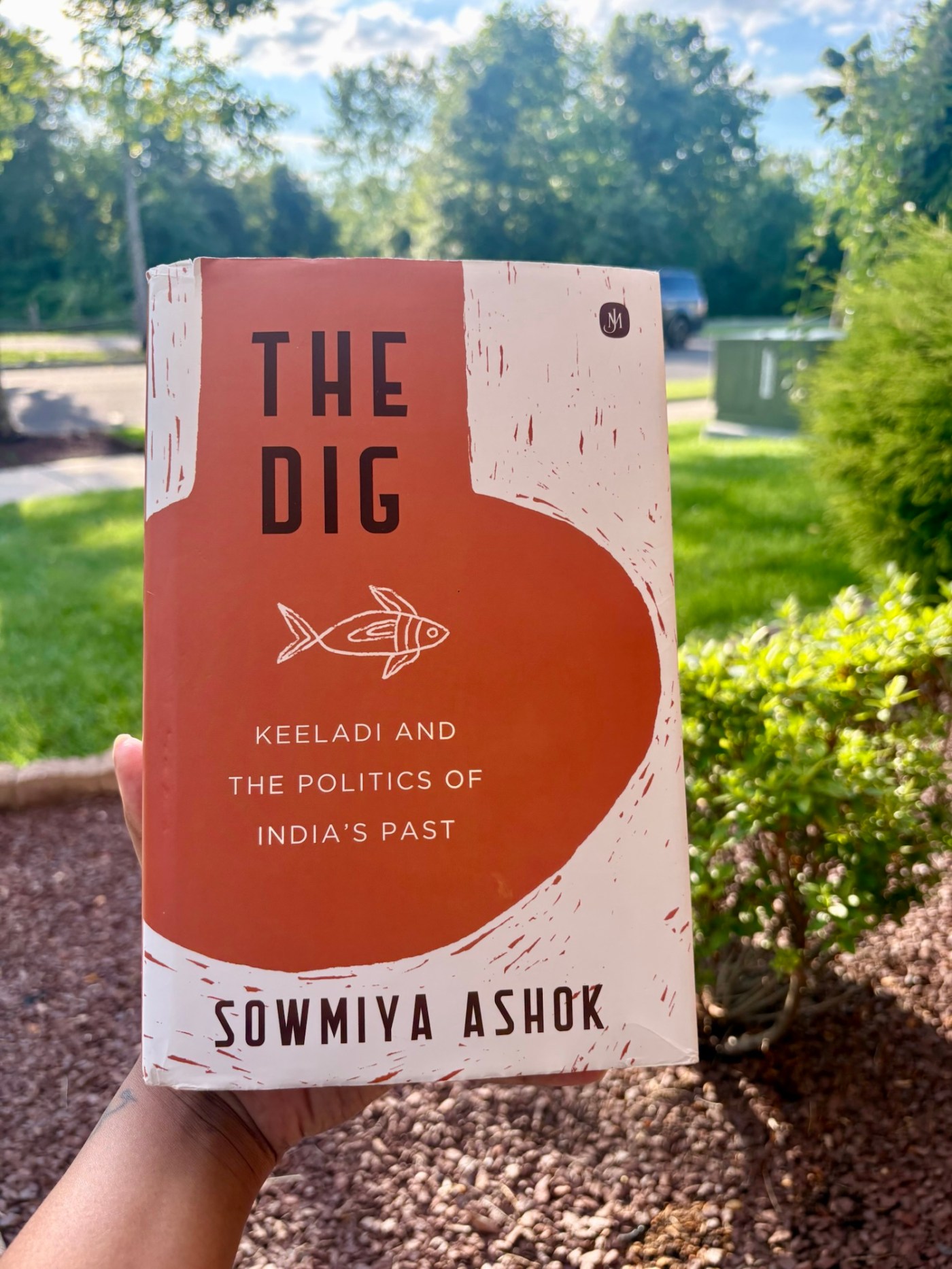
Some books answer questions. Others leave you asking better ones. The Dig by Sowmiya Ashok belongs firmly in the latter category. At its heart, the book asks deceptively simple questions: Who are we? Where did Indians come from? And how much of what we confidently believe is actually supported by evidence?
Simple questions. Yet the hardest ones to answer.
Growing up, many of us have encountered the Aryan-Dravidian debate in one form or the other. Layered on top are the colonial interpretations, nationalist counter-narratives, and countless theories about the origins of Indian civilization. It is tempting to choose the version that best fits our beliefs. But theories no matter how compelling they are, must always stand on evidence.
There is no one spectacular discovery that settles every argument. It is a conversation that stretches across centuries. Every trench, every potsherd, every inscription, every poem, and every strand of DNA adds another fragment to an enormous mosaic. Archaeology, genetics, linguistics, literature and anthropology all became pieces of a puzzle that is still incomplete.
One of the greatest surprises while reading this book was realizing how archaeologists actually think. I imagined grand monuments, inscriptions and buried cities. Instead, I was fascinated by knees, toes and tiny deformities in bones. How do you know whether a woman who lived 10,000 years ago belonged to a farming community or a foraging band? You look for repetitive stress injuries left on the bones by years of grinding grain. How do you know if someone frequently rode horses? A small change in the hip joint gives us the clue. Agriculture appears to have developed independently in both the Indus and the South. Even metallurgy tells stories. Copper alloys from South India had Arsenic additives resembling Harappan metallurgy! Reservoirs in the Indus Valley reveal how ancient people adapted to dwindling rivers. Scripts reveal trade networks. Pottery reveals migration. History is often reconstructed from details so small they would escape the notice of almost everyone else. Archaeology is less about spectacular discoveries and more about patiently assembling thousands of tiny clues.
I had to reflect on my own story. My father’s ancestral lineage traces back to northern India. Despite his “Aryan” roots, he’s dark-skinned and looks like a “typical South Indian.” On the contrary, my mother, whose ancestry probably lies in Kerala, is a fair-skinned “Dravidian”. I have often been mistaken for a Malayali, Bengali, North Indian, and occasionally even a foreigner. Neither genealogy nor physical appearance captures who we are. Nobody today is “pure.” We are, quite literally, products of millennia of migration and mixing. But culturally, my family has been Telugu for generations! That is the language we speak, the traditions we inherit, and the identity we call our own. Culture cannot always be inferred from genes, skin colour, or appearance. There is a difference between biological ancestry and cultural identity. DNA can tell us where populations moved. It cannot fully explain who people believed themselves to be.
It’s no surprise that my favourite sections of the book were stories from South India. Andaman tribes are the first modern humans who migrated out of Africa about 65,000 years ago. Keezhadi, Adichanallur, Sivagalai, Korkai and Pattanam are names that deserve to be as familiar to us, as much as Harappa and Rakhigarhi. These sites demonstrated that Sangam literature was not merely poetic imagination but reflected a lived society. It tells us that ancient India contained multiple cultural traditions developing alongside one another. Quoting some of my favorite lines from the book here:
“If the South of India was using literary texts to fill the gaps in archaeological work, the North was using new archaeological evidence to validate religious texts. It is not possible to pull a poem out of a trench, just as we cannot pull a city out of a poem. Yet in modern India, that was exactly what was happening”.
“When we were living beyond Vindhyas, we did not require buildings constructed out of bricks. Even Rajaraja, the Chola king, did not have a huge palace. His son Rajendra’s palace at Gangaikondacholapuram only had a brick base. The superstructure was made of wood. Why do we even expect buildings from those who lived in these hotter regions?”
“Why wasn’t the common man writing in the north of the country if there were already great epics like the Ramayana and Mahabharata? Other than Ashokan edicts, there is no other evidence of writing in north India. When we look at it, we realize that it was an administrative language, not a language of the common man.”
“The contribution by Jains to Tamil is a script for the language leading to literacy and the efflorescence of Sangam literature in the early centuries.”
“Socio-politically speaking, the Sangam age came to represent an idealized non-Brahmin, non-caste past, which gave the Dravidians a distinct identity. The largely secular nature of Sangam literature contrasted with the religious and pedantic nature of Sanskrit literature.”
“Caste system did not exist until roughly 2,000 years ago. Before that, people mixed freely with one another. Despite its excessive importance, the caste system did not leave its mark on our genes.”
“Pandyas ruled from 500 BCE to 1759. Who else ruled that long in India? Nobody. But why are we not highlighting the Pandyas?”
We often ask why South India did not build monumental stone cities like those elsewhere. But why should it have? There were no densely packed cities in Mediterranean style here because it was too hot. The mighty Chola wooden superstructures have long since disappeared. The pompous structures of the Greco-Roman world did not influence the Tamil people of the classical age. South India did not need monumental architecture to demonstrate civilizational sophistication. It may instead have been a society where literacy extended well beyond royalty, where even ordinary people could read and write. The polity here was horizontal and content. That is a different, but equally compelling marker of advancement. The greatness of Tamil is not in its antiquity, but in its continuity. The grand temples all across the South from Tanjore to Madurai stand as a testimony to this continuity.
Pepper and ideas travelled across continents. The pearls of Korkai were talked about in the Roman Senate for bleeding the empire dry. Pattanam’s connection with Rome reminded me that the Indian Ocean was never just ours. The fall of the Roman Empire had ripple effects in Kerala. Perhaps an ancient pepper trader tried to convert his trading warehouse into a banana garden. History has always been global.
Also, unlike the literature in the North, Sangam poems even make light of the Gods and call them out. I was reminded of its parallel with Chatuvulu in Telugu where a poem reads: “సిరి గల వానికి చెల్లును తరుణులు పదియారు వేలు తగ పెండ్లాడన్, తిరిపెమున కిద్దరాండ్రా పరమేశా గంగ విడుము పార్వతి చాలున్”. It was written by Srinatha Mahakavi during a drought, calling Shiva a poor beggar who shouldn’t have multiple wives like the wealthy Vishnu, asking him to keep Parvathi but let go off Ganga, so he can quench his thirst!
One of the greatest strengths of the book is its refusal to romanticize. The Lemuria theory that humanity spread outward from an ancient Tamil homeland is undeniably captivating. Genetics simply do not support that hypothesis. What is popularly called the Aryan “invasion” is better understood as multiple waves of migration occurring over long periods rather than one dramatic event. The problem is that captivating stories are not necessarily true. Evidence should shape our stories. Our stories should not dictate the evidence.
Another line from the book quietly stayed with me: “Archaeology is often a recorded destruction. Archaeological excavations are often places where villages become sites of negotiation between the living and the dead.” It is a beautiful paradox. We preserve history only by disturbing it. Every excavation uncovers the past, but it also permanently alters the context in which that past was preserved. Every discovery is both revelation and loss.
Harappan cities began to decline around 1900 BCE, while the Vedic culture is said to have emerged only around 1500 BCE. The Harappans built well-planned cities, but Vedic people were pre-urban and primarily pastoral. The Rigveda mentioned cities only as ruins, believed to be haunted, which the Vedic people would enter only to collect broken pottery for their rituals. What happened between 1900 BCE and 1500 BCE is a mystery!
The Harappan sites show a proliferation of Mother Goddess idols in private homes, while Rigveda contains no prominent female deity associated with any fertility cult. But the Adichanallur copper alloy mother goddess strikingly resembled the Indus female terracotta figurines with the same kind of headdress and waistband. It is also possible that IVC’s language was an early form of Dravidian. Brahui, still spoken in Balochistan and parts of Iran, is a Dravidian language. Is the Porunai and Vaigai Civilisation in the South a continuation of the Indus Valley Civilisation?
The deeper we dig, the more history refuses to fit into neat boxes. Perhaps what I appreciated most was the author’s restraint. The book does not attempt to prove an ideological position. Instead, it carefully distinguishes between evidence, interpretation, and speculation.
I closed the book without having all my questions answered. Instead, I found myself asking better ones.
Who were we?
How much do we truly know?
And how much of our history still lies beneath the soil, waiting patiently for the next careful dig?
That, perhaps, is the greatest achievement of The Dig. It reminds us that history is not a finished story. It is still being unearthed.


Leave a comment