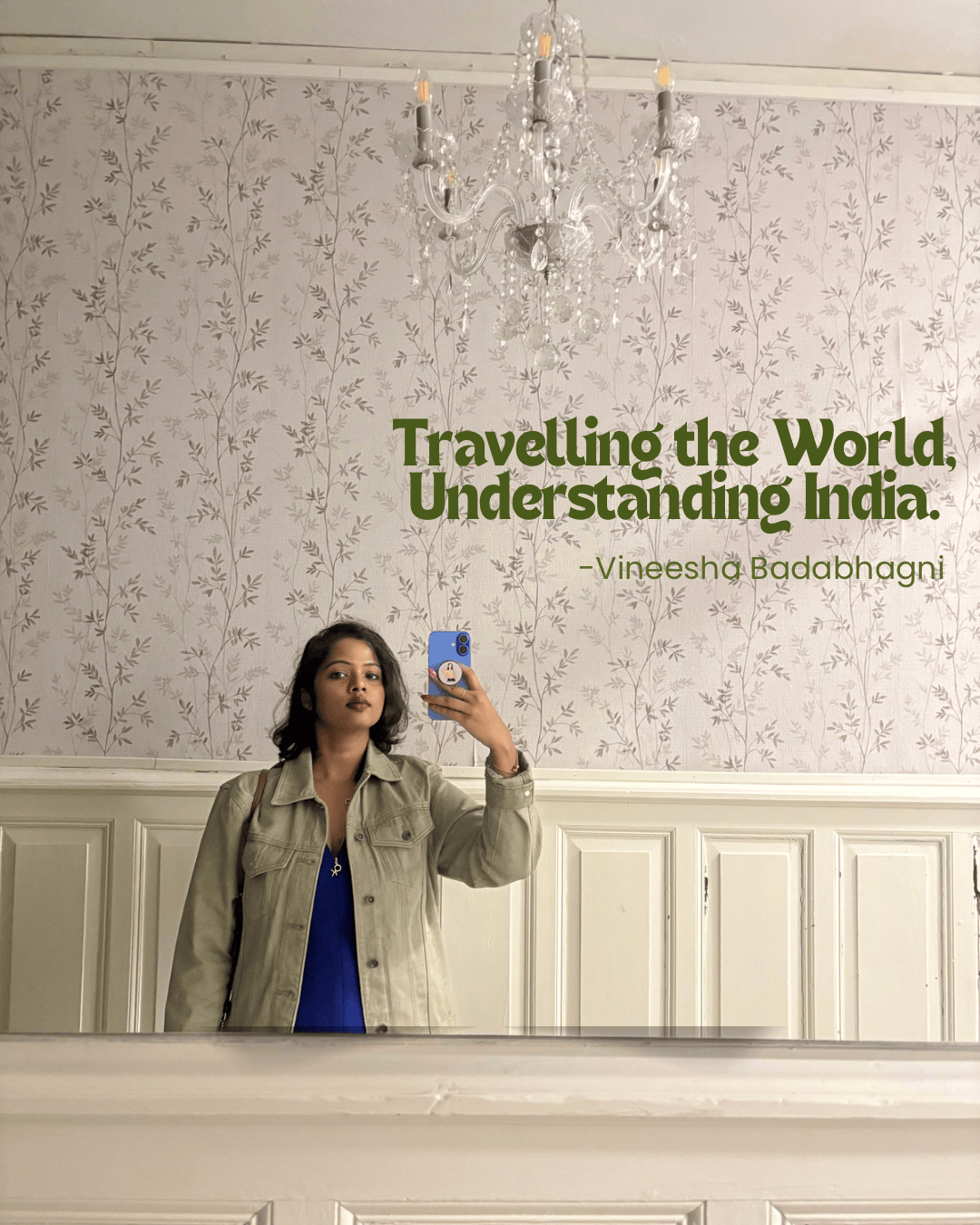
Travel has a peculiar way of changing how you look at your own country. It exposes you to different cultures, communities, ways of life and, more importantly, different standards of living. But beyond the food, landscapes and experiences, what stays with you are the stories of people. When you spend time with locals, listen to their experiences and understand the challenges their societies face, you inevitably begin comparing those stories with the story of your own country.
Every journey leaves you with a different perspective. Sometimes, it makes you question where your country stands. At other times, it makes you appreciate things you might have otherwise taken for granted.
Having travelled extensively, I’ve increasingly found myself reflecting on India.
Look around the world today. Several countries are grappling with deep-rooted regional, ethnic, religious, and political divisions. In some places, these fault lines have escalated into civil unrest, internal conflicts and even wars with neighbouring countries. You begin to understand how difficult nation-building really is.
And then you think about India.
A country with hundreds of languages and dialects, multiple religions, thousands of communities, ethnicities, tribes, castes and deeply entrenched social differences. A country that inherited centuries of social practices, inequalities and contradictions. A country that was once dismissed by many as an unlikely democratic experiment.
Yet, here we are.
India’s survival as a unified democracy is, in itself, an extraordinary experiment in nation-building. It hasn’t been without conflict, disagreement or setbacks. But somehow, through all its contradictions, the country has continued to evolve.
Sometimes, we need to pause and appreciate just how remarkable that journey has been.
We came from a society where practices such as Sati existed, where social hierarchies were deeply entrenched and millions lacked access to basic opportunities. Today, when I travel abroad and introduce myself as an Indian, the response is increasingly different. People recognise India as an emerging global power. Conversations around the power axis and global politics include India now.
It is a fascinating transformation. But I think it is also a good time to pause and reflect on what made this possible.
We often take for granted the institutions, policies and governance frameworks that have quietly shaped our lives.
Take the Constitution, for instance. In a country as diverse as India, having a constitutional framework that guarantees fundamental rights, establishes democratic institutions and provides a common foundation for governance is no small achievement.
Look at the policies that have attempted to address some of our most fundamental challenges. MGNREGA/VBGRAMS created a statutory framework for providing wage employment in rural India. The Right to Education sought to make elementary education a fundamental right. Mid-day meal programmes helped address both classroom participation and child nutrition. Right to Information brought accountability into the system. Public healthcare initiatives and health insurance schemes attempted to make healthcare more accessible. Financial inclusion, microfinance and credit support for small businesses opened up opportunities for millions who were historically excluded from formal financial systems.
Then came the digital revolution. Direct Benefit Transfers helped reduce intermediaries and corruption in welfare delivery and brought greater transparency into the system. Digital payments changed how people transact. Financial inclusion initiatives brought millions into the formal banking ecosystem.
None of these interventions are perfect. Many have their own implementation challenges. But collectively, they represent decades of policy experimentation, institutional development and administrative effort.
India’s success story cannot be attributed to one government, one policy or one defining moment. It is the cumulative outcome of bureaucrats who designed and implemented policies, politicians who took decisions, entrepreneurs who built businesses, and millions of ordinary citizens who contributed to the country’s progress. It is important to acknowledge this collective effort.
Of course, none of this means that India has solved its problems. We are far from it.
Our government hospitals remain overburdened. Public schools need better infrastructure, and teachers and curriculum. Basic civic sense continues to be a challenge in many parts of the country. Children are still suffering on the roads. Last-mile delivery of welfare schemes needs constant improvement. We still have significant gaps in sanitation, urban planning, public infrastructure and access to essential services.
There are more than ten thousand other problems waiting to be addressed. From a governance perspective, every unresolved problem is also an opportunity to make things better.
The job of a government is not to pretend that everything is working. Its job is to keep trying. To identify gaps, experiment with solutions, course-correct, build institutions and continuously improve the quality of life of its citizens.
When you step outside your own familiar environment, you realise that no country has all the answers. You see different models of governance, healthcare, education, economic development and social organisation. You observe what works in democracies, monarchies, single-party systems and even countries with very different political structures.
We should be equally willing to learn from countries across different faiths, cultures and political systems. The objective is not to find one perfect model, but to identify what works and tailor those learnings to India’s unique circumstances.
You also realise that sometimes, other countries you least expect from, have already addressed problems much sooner than yours. Take Triple Talaq abolition for instance. India was late to the bus, when several Muslim countries already abolished the practice giving women their due rights. It is a reminder that progress is not always linear and that there is much we can learn from experiences elsewhere.
The idea should not be to blindly replicate the West or the East, or to measure ourselves against any one country. Every society has its own historical, cultural and economic realities. What works in one place may not necessarily work in another. But we should be willing to observe, learn and adapt.
I often find myself feeling proud of how the Indian experiment has survived. There are countless things we still need to fix. There are institutions that need strengthening, policies that need rethinking and communities that still need to be brought into the development journey.
But perhaps, every once in a while, we should pause and acknowledge the journey itself.
We should remember the bureaucrats, policymakers, politicians, entrepreneurs, reformers and ordinary citizens whose collective efforts brought us here. We should appreciate the institutions that have endured and the policies that have made a tangible difference to people’s lives.
And then we should get back to work.
Because being proud of India and being critical of India are not contradictory ideas. In fact, they should go hand in hand.
Travel has made me appreciate India a little more, question it a little more and understand it a little better.
I’m proud of how far this extraordinary experiment has come. And, despite everything that remains to be done, I’m incredibly optimistic about where it is headed.


Leave a Reply