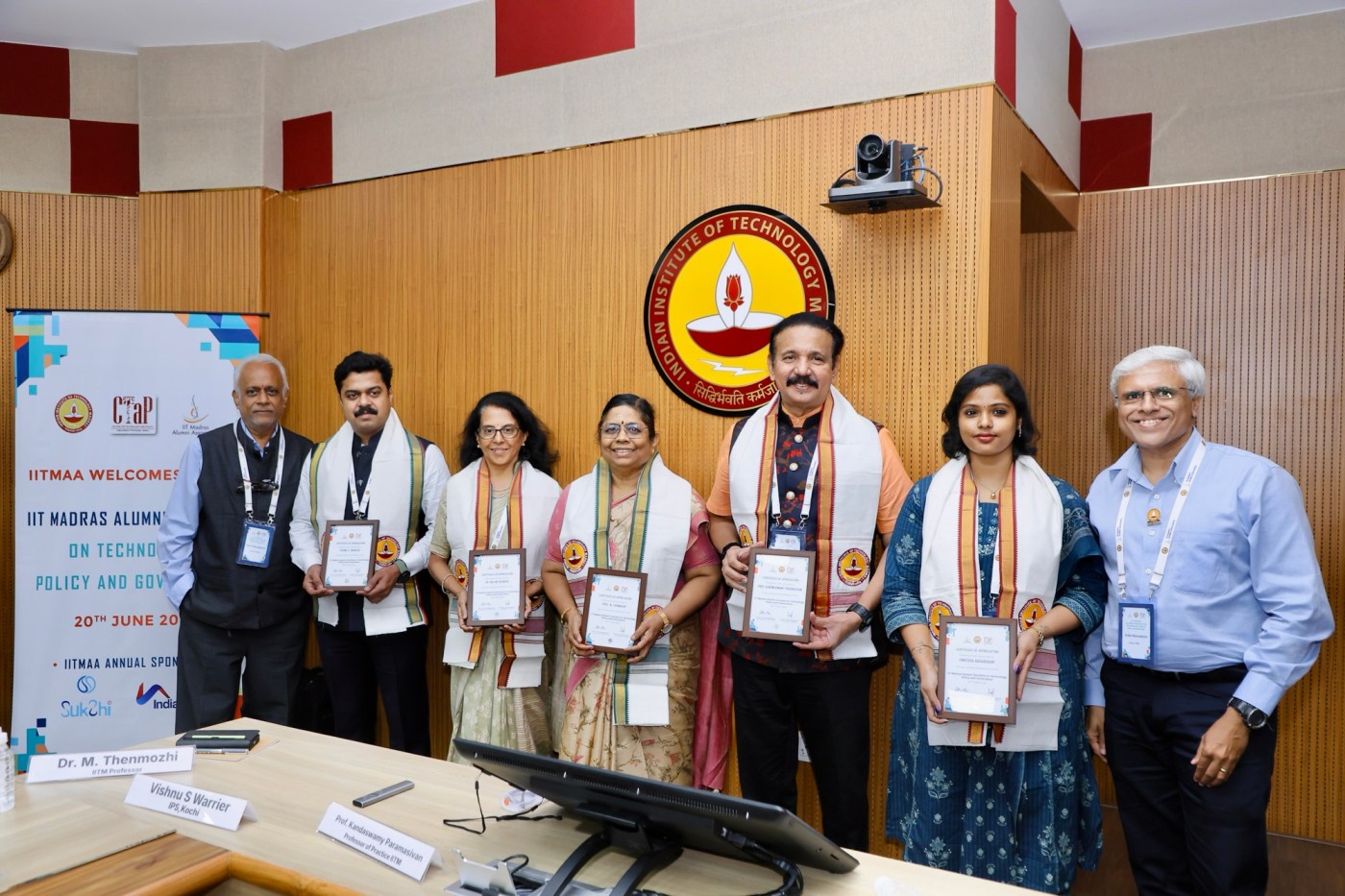
Returning to IIT Madras after eight years was nostalgic. Returning to discuss public policy, governance, technology, and nation-building with fellow alumni serving across the country was something else entirely.
The event, jointly organized by the Centre for Technology and Policy (CTaP) and the IIT Madras Alumni Association, brought together an unusual cohort of serving and retired civil servants, academicians, and policy thinkers. Despite representing different generations and domains, we shared one common identity: IIT Madras.
There were a number of interesting discussions and reflections that emerged through the day. I thought it would be worthwhile to capture some of them, not just for fellow officers, but for anyone interested in governance, policymaking, and how ideas eventually translate into action. What emerged was not merely a discussion about governance. It was a reflection on how India can better bridge the gap between ideas and implementation.
The Realities of Public Service:
One recurring theme throughout the discussions was something that anyone in government would immediately relate to. Often, we can see the solution to a problem quite clearly. The challenge is not identifying the answer; it is implementing it at the pace we would like. That, in many ways, is the reality of governance.
We spent some time discussing how officers often have too much on their plate. The interesting thing is that when they don’t speak about it, their plate simply keeps getting fuller. As one moves up the ladder, responsibilities continue to expand. There will always be more work than time. The question is not how to avoid that reality, but how to communicate resource requirements effectively. How do you tell leadership that expectations are increasing but resources are not? How do you ask for additional support in a constructive manner? And how do you establish healthy boundaries without compromising your commitment to public service?
These are not easy questions, especially because public servants operate amidst a wide range of stakeholders like citizens, political representatives, senior bureaucrats, leadership, private companies, consultants, academia, and many others. Every decision sits at the intersection of competing priorities. Somewhere in all of this, protecting one’s own mental well-being becomes important too. In a profession where service often extends beyond office hours, preserving one’s mental resilience is not a luxury. It is a necessity.
Another discussion revolved around postings and field administration. We often focus on learning the local language when we move to a new place, but language alone is not enough. Understanding culture is equally important. Policies may be designed in capitals, but they are implemented in communities. To work effectively in public service, one has to understand the finer nuances of a place, the social dynamics, local aspirations, and unspoken realities that never find their way into official reports. The most effective officers are often those who invest time in understanding people before attempting to change systems.
During these discussions, I shared one thought that I have always strongly believed in: your reputation should precede you. When you walk into a new posting, people should already know what you stand for. They should know that corruption will not be tolerated. They should know that issues such as sexual harassment at workplace will be taken seriously. POSH provisions will be invoked, and perpetrators will be given the highest punishment. They should know what your red lines are.
A good reputation is not built overnight, but once built, it becomes one of the most invisible yet effective administrative tools available to an officer. It reduces ambiguity, aligns expectations, and often prevents problems before they arise. In public service, credibility is among the most valuable forms of capital.
Another recurring issue was continuity within government. Frequent transfers mean that officers spend months understanding legacy issues, stakeholder relationships, and institutional history, only to move on and take that knowledge with them. Much of the transfer of this knowledge remains person-driven rather than process-driven. Corporate organizations address this through structured handovers and knowledge transfers. Governments could benefit from similar mechanisms. One suggestion that emerged was a mandatory charge-handover note. Not just a formal transfer of files, but a structured note documenting major legacy issues, lessons learned, stakeholder sensitivities, and practical advice for whoever occupies the chair next. Such a simple intervention could preserve enormous amounts of institutional memory.
When Academia Meets Governance:
The conversation then moved towards the long-standing relationship between IIT Madras and public policy. One of the former Directors of IIT Madras, while delivering the keynote address, shared an interesting example. The institute had developed a low-cost housing solution that was technically sound and scalable. On paper, it seemed like an excellent idea. However, the project eventually had to be halted at the policy level because of concerns that colony-style housing could inadvertently create further segregation of already disadvantaged communities.
That example stayed with me because it highlighted something important. Academia often sees the engineering challenge. Policymakers, on the other hand, are forced to consider the social consequences as well. There are realities that are obvious to one side but invisible to the other.
Another story illustrated this even better.
Researchers had been working on ways to generate electricity from processes that are already being used in tapioca production. Since boiling is an integral part of the process, there was potential to use the waste heat for electricity generation. A meeting was organized with large tapioca farmers and processors. The researchers enthusiastically explained the concept, only to discover that many of the farmers were already generating electricity.
The response from the researchers was immediate. “That’s fantastic. Then why not generate more and sell it back to the grid?”
The answer surprised everyone. The farmers said, “If we cross one Mega Watt, the Pollution Control Board starts knocking on our doors. We don’t want the additional compliance burden.”
Suddenly, the problem was no longer technological. The technology already existed. The constraint was regulatory. That discussion really struck me. We often assume that innovation requires new inventions. Sometimes innovation simply requires removing barriers that prevent existing solutions from scaling!
A large part of the day was also spent discussing how government, academia, and industry can work together more effectively. Government generates problem statements. Academia generates ideas. Industry provides capital and execution capability. In theory, this sounds like a perfect ecosystem. Yet these three ecosystems frequently operate in isolation. We discussed examples ranging from crowd management systems to tackling misuse of decentralized platforms by extremist groups. There are countless public policy problems that could benefit from academic intervention.
The challenge is speed. Government problems evolve rapidly. Academia often approaches them as multi-year research questions. By the time a solution arrives, the problem itself may have changed.
It is like the famous Choluteca Bridge. The bridge was built over a decade in Honduras, but the river changed course because of a hurricane. The structure remained intact, but it no longer solved the problem it was built for.
That analogy captured the challenge perfectly.
A solution delivered years after a problem emerges is no longer relevant. This requires a shift from viewing every challenge as a long-term research project toward creating mechanisms for rapid experimentation, deployment, and scaling. The real opportunity lies in converting these ideas into deployable solutions and viable enterprises, ensuring that innovation does not end at publication but reaches implementation at scale.
An interesting debate also emerged around the growing role of consultants in governance. Consultants undoubtedly provide expertise and execution support. The other edge to the sword is how consultants have become more bureaucratic than bureaucrats themselves. However, an uncomfortable question surfaced: Are we outsourcing execution, or are we gradually outsourcing thinking itself? There was more reflection than answer to this question.
Could academia play a larger role here? Supplementing the over-reliance on today’s consultants? Again, the issue is speed of delivery.
One professor made a particularly interesting observation. He said that if you tell a professor they will make money by solving a problem, that may not necessarily motivate them. But if you tell them they will contribute to nation-building by solving it, the response may be very different. That got me thinking about how often we import institutional models from elsewhere without adequately understanding what motivates people in our own context.
Strategic Indispensability and Technology Sovereignty:
While many conversations focused on governance challenges, the discussion also ventured into a broader question: what role should India play in shaping the future rather than merely responding to it?
The discussion expanded into the Economic Survey’s idea of India’s strategic indispensability. For a long time, the assumption was that India would become geopolitically significant because its economy would continue to grow. Increasingly, however, the relationship appears to be working both ways. For India to sustain economic growth, it must also become geopolitically significant. That means taking positions on global issues. It means developing technological sovereignty. It means ensuring that India matters enough that disruptions affecting India become disruptions affecting the world.
One phrase that came up repeatedly was that India has to punch its weight.
Technology emerged repeatedly as a strategic theme. Whether discussing semiconductor ecosystems, artificial intelligence, energy technologies, or advanced manufacturing, the message was consistent: technological dependence creates strategic vulnerability. A nation that cannot build critical technologies eventually becomes dependent on those who can. This extends beyond today’s technologies. History shows that countries gain advantages when they invest early rather than waiting for certainty.
There was also a fascinating discussion on energy security. Given the uncertainties in West Asia, conversations touched upon Arctic projects, the Vladivostok-Chennai corridor, and the need to diversify India’s energy sources. The objective, ultimately, is not to predict the future perfectly but to diversify risk intelligently.
One observation that particularly stayed with me was about the United States and India. India occupies a unique position globally. It does not fit neatly into many existing strategic frameworks. It is not West Asia. It is not comparable to much of South Asia. Nor is it a treaty ally in the same manner as several Indo-Pacific partners of the United States. The inability of existing frameworks to adequately accommodate India’s position may become a challenge in itself.
The discussion then shifted towards future technologies. Today, there is significant focus on Small Modular Reactors (SMRs). But somebody raised an interesting point: should we already be thinking about Micro Modular Reactors (MMRs)? If an institution such as IIT Madras requires around 15 MW of power, could future campuses eventually have compact modular systems functioning almost like nuclear batteries? The broader argument was not about one specific technology. It was about parallel thinking. When India developed rocket technology, work on different propulsion systems like solids, liquids, cryogenic happened in parallel. We did not wait for one technology to mature completely before exploring the next. Perhaps a similar mindset is required here as well.
This led to a broader reflection on how we react to emerging technologies. Very often, we overestimate short-term impact and underestimate long-term transformation. Take AI as an example. Much of today’s conversation revolves around its flaws and limitations. Yet it is entirely possible that the same technology will fundamentally reshape entire sectors in the years ahead. Customer support may be one such example. The tendency to focus on current imperfections often prevents us from appreciating future possibilities.
Towards the end of the event, I asked a question that had been on my mind for some time. As young officers, we often encounter policies that may be well-intentioned but difficult (often impractical) to implement on the ground.
How do we communicate these realities while remaining aligned with leadership? In short, how do you tell the leadership that a policy is not going to work?
A very senior officer gave me a remarkably simple answer.
“Look them in the eye and say it.”
She repeated it.
“Look them in the eye and say it.”
Not confrontationally. Not disrespectfully. But honestly, respectfully, and with evidence. Leadership, she said, will appreciate honesty more than silence.
That advice stayed with me long after the event ended. It was, in many ways, the perfect conclusion to a day spent discussing governance, ideas, and implementation.
As I left the campus, one thought remained. India does not lack talent. Our universities generate ideas. Our policymakers understand societal needs. Our industries possess scale and execution capabilities. The challenge is building stronger bridges between them.
If academia can better understand implementation realities, if policymakers can create enabling frameworks, and if industry can help scale solutions responsibly, we can dramatically accelerate public value creation. The future will not be built by government alone, academia alone, or industry alone. It will be built in the spaces where they collaborate. And perhaps that was the true significance of this gathering. Not merely the conversations we had, but the bridges it reminded us we still need to build.


Leave a comment