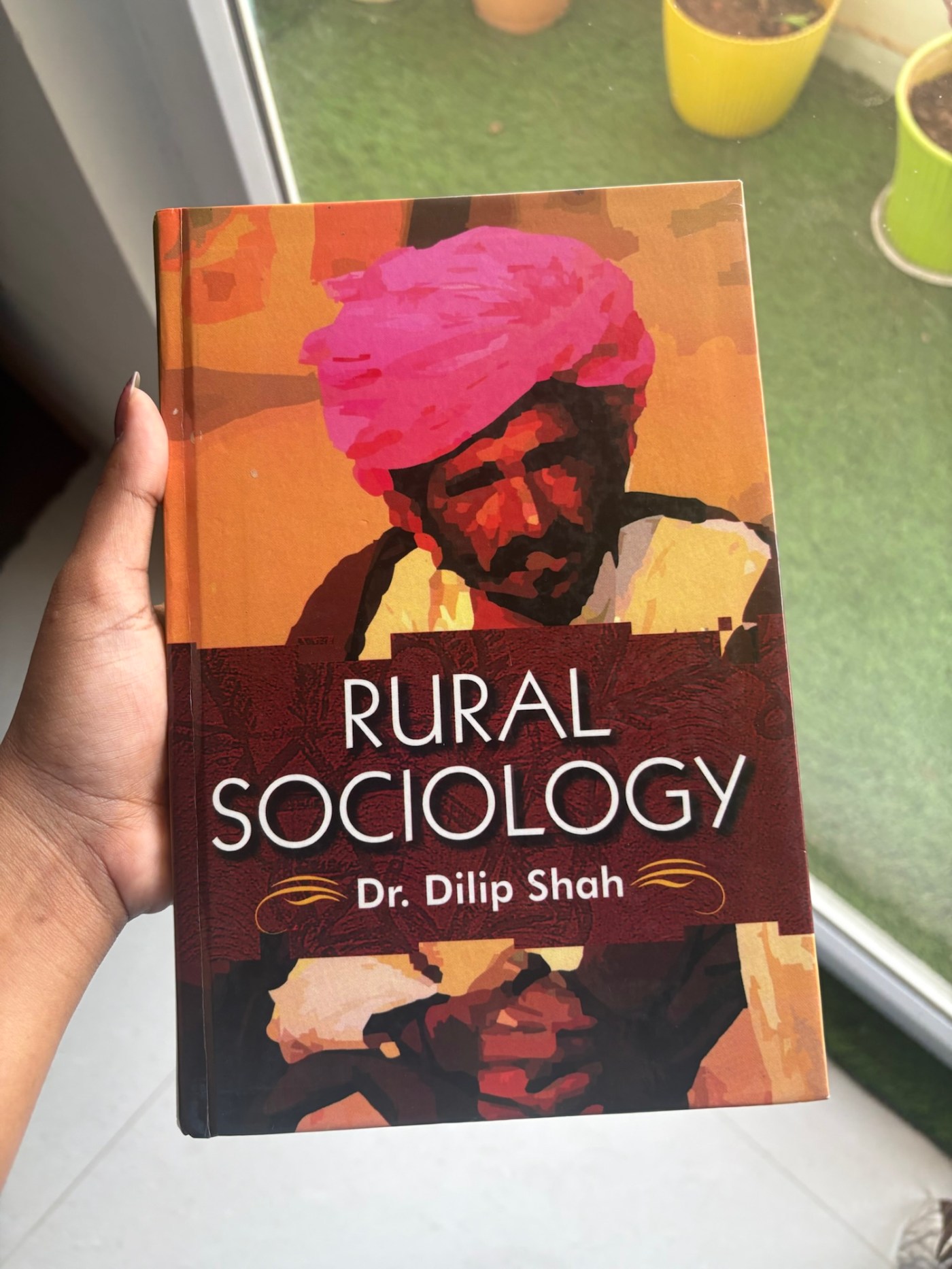
Rural Sociology by Dr. Dilip Shah is not a page-turner. It is not meant to be. It is an academic text that’s structured, dense, and methodical.
For anyone unfamiliar with the rural social structure of India, it serves as a foundational introduction. It presents a holistic view of how caste, economy, land relations, welfare programmes, and political institutions intersect in shaping rural India.
One of the strongest contributions of the book is its insistence that rural society is not homogeneous. It carefully highlights the differences between rich capitalist farmers, bullock capitalists, poor peasants, and agricultural labourers. When we speak of “Agriculture Policy”, a unitary solution cannot address all the groups. Policy must be conscious of differentiated rural classes and must deliberately prioritize the upliftment of the poorest peasants rather than assuming uniform benefit.
The discussion on the Panchayati Raj system is equally sobering. While decentralization brought politicization into rural areas and created new avenues of participation, it has not dismantled deeply embedded social hierarchies. Instead, what we often see is a parallel institutional system that remains underpowered as it lacks adequate funds, functionaries, and functional autonomy.
The observation in the book that relations in rural society are largely cooperative, in contrast to urban areas where relationships tend to be contractual, offers a powerful sociological lens. It captures the embeddedness of rural life where economy, kinship, caste, and culture are intertwined rather than compartmentalized.
Equally striking is the warning against mechanically transplanting reform models from contexts like the United States, a nation historically characterized by abundant land and smaller agrarian populations, onto India where land is scarce and agrarian density is high. Such policy mimicry has historically produced distortions rather than transformation.
The book also draws an important distinction between rural sociology and anthropology. Rural sociology operates at the level of generalized national trends and statistical analysis, whereas rural anthropology is grounded in intensive, localized fieldwork. Village becomes the meeting ground of both disciplines. It is the theater where rural life unfolds in all its layered complexity.
For anyone engaged in governance, this book quietly challenges the temptation of one-size-fits-all solutions.
 Vineesha Badabhagni
Leave a comment