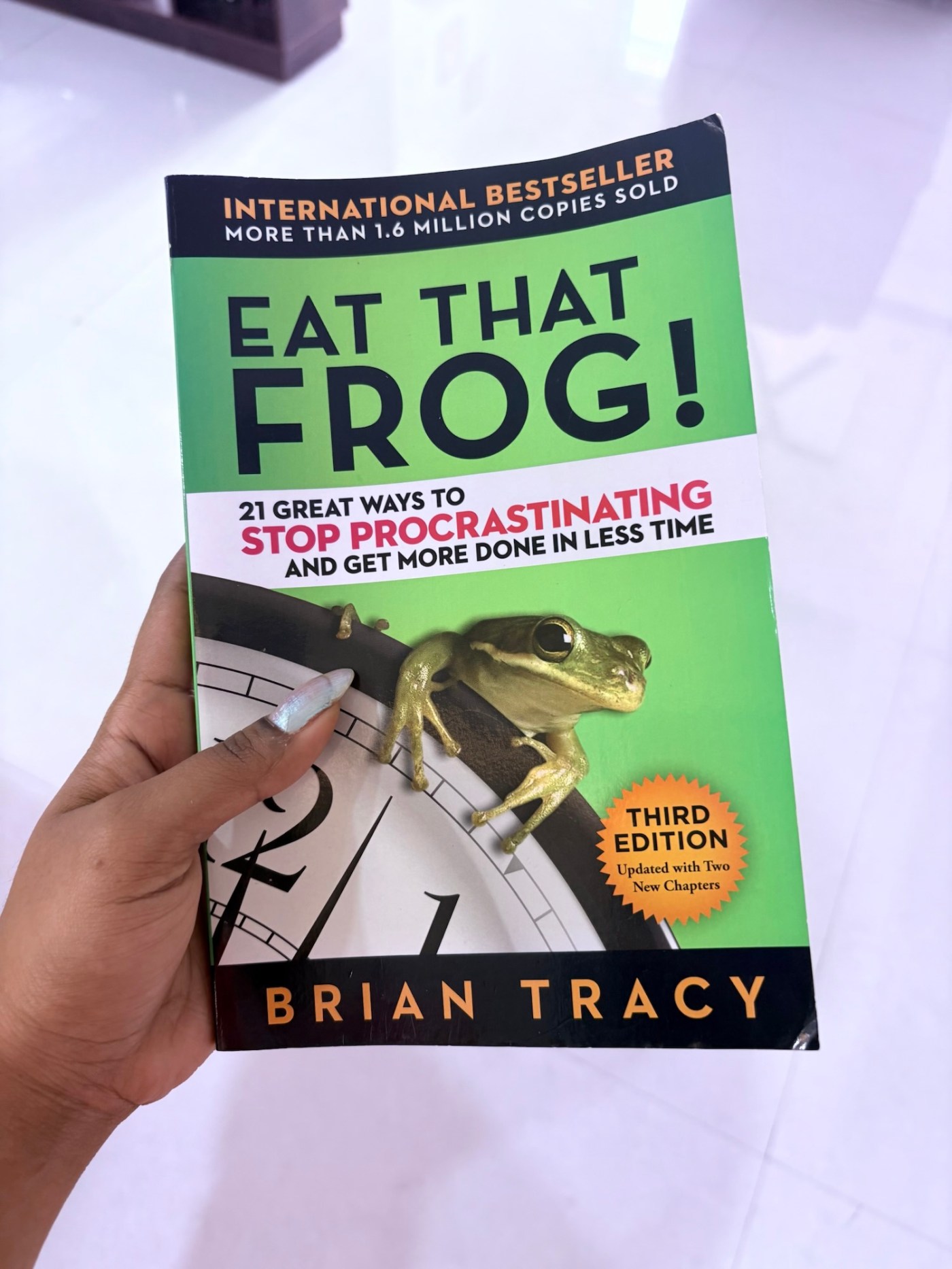
As strange as it sounds, this little frog book was packed with surprisingly gross yet incredibly practical advice on leveling up. It’s all about tackling high-value tasks head-on while also finding that sweet spot of balance, ikigai. I made a few quick lifestyle tweaks based on it, and honestly, these mantras work.
Sharing my favorite lines from Brian Tracy here — because some things are worth re-reading, right?
❤
- If the ladder is not leaning against the right wall, every step we take just gets us to the wrong place faster.
- A goal that is not in writing is merely a wish or a fantasy. It has no energy behind it.
- A goal without a deadline has no urgency. It has no real beginning or end.
- In your list, the “vital few” tasks and “trivial many” tasks take same time for each task. Resist the temptation to clear up small things first. Hit off high value tasks first. Spend more time on areas that can make real difference in life and career. Spend less and less time on lower-value activities.
- The 80-20 rule also applies to constraints in achieving goals. 80% of constraints are usually internal, related to abilities, habits, and discipline. Only 20% are usually due to external factors like markets and governments.
- There is never enough time to do everything, but there is always enough time to do the most important thing.
- You cannot eat every tadpole and frog in the pond, but you can eat the biggest and the ugliest one, and that will be enough, at least for the time being.
- The question you have to keep asking yourself continuously is “What can I and only I do, that if done well, will make a real difference?” What is this frog that if you don’t eat, it won’t be eaten by anybody else?
- The things that matter the most must never be at the mercy of the things that matter the least.
- The fact is that you can’t do everything that you have to do. You have to procrastinate on something. Therefore, deliberately and consciously procrastinate on small tasks. Put off eating smaller or less ugly frogs. Eat the biggest and ugliest frogs before anything else. Do the worst first!
- Everyone procrastinates. The difference between high performers and low performers is largely determined by what they choose to procrastinate on.
- Decide to procrastinate on, outsource, delegate, and eliminate those activities that don’t make much of a contribution to your life in any case. Get rid of the tadpoles and focus on the frogs.
- Say no to anything that is not a high-value use of your time and your life. Say no graciously, but firmly to avoid agreeing to something against you. Say it early and say it often. Remember that you have no spare time. As we say, “Your dance card is full”.
- A major reason for procrastination is a feeling of inadequacy, a lack of confidence, or an inability in a key area of a task.
- Upgrading skills is the most important productivity principle. The better you become at eating a particular type of frog, the more likely you are to just plunge in and get it done.
- Anytime you stop striving to get better, you’re bound to get worse. Continuous learning is the minimum requirement for success in any field.
- Whatever your answers to questions are, take action immediately. Do something. Do anything. But get started.
- Lead the field. See yourself as a role model. Raise the bar on yourself. The standards you set for your own work and behavior should be higher than what anyone else could set for you.
- Technology becomes the enemy when we give in to an obsessive need to communicate continually. It leaves us psychologically breathless. We have no time to stop, smell the roses, and collect our thoughts.
- Create zones of silence during day-to-day activities. Turn off your computer and smart phone for one hour in the morning and one hour in the afternoon. Your mind will be calm and clear. When your mental batteries have time to recharge, you will be much more effective at eating frogs.
- Having ten different ways to communicate is an overkill. Keep alternate communication channels for personal affairs and important clients. Segment these channels so that only frogs, not tadpoles, can hop into your castle of concentration.
- The beginning of a habit is like an invisible thread, but every time we repeat the act, we strengthen the strand, add to it another filament, until it becomes a great cable and binds us irrevocably, in thought and act.
- Think continually of different ways that you can save, schedule, and consolidate large chunks of time. Use these times to work on important tasks with the most significant long-term consequences.
- The fact is that everybody has both strengths and weaknesses. Refuse to rationalize, justify, or defend your areas of weakness. Instead, identify them clearly. Set a goal and make a plan to become very good in each one of those areas.
- By not working effectively and efficiently during your workday, you create unnecessary stress, and deprive the members of your family of the very best person you can possibly be.
It is the quality of time at work that counts and the quantity of time at home that matters.
❤
 Vineesha Badabhagni
Leave a comment